
Blog
What Is ADHD? Symptoms, Types, Causes, Diagnosis and Treatment in Europe and America in 2026
Aug
What Is ADHD?
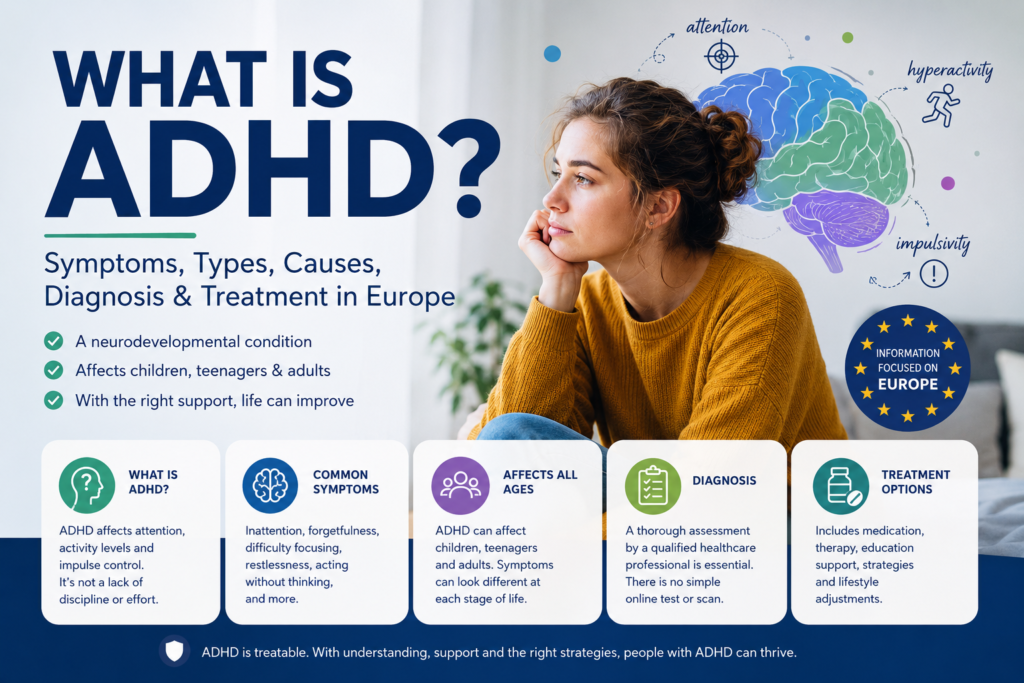
ADHD, or attention-deficit/hyperactivity disorder, is a neurodevelopmental disorder that can affect attention, activity levels, impulse control and the ability to regulate behaviour and emotions.
Although ADHD is often associated with children who are restless or unable to concentrate at school, the condition is much broader than that. ADHD can affect children, teenagers and adults, and its symptoms can look very different from one person to another.
Someone with ADHD may struggle to organise tasks, remember appointments, complete lengthy activities, control impulses, manage time, remain focused during conversations or regulate their level of activity. Other people may experience predominantly inattentive symptoms and have little obvious hyperactivity.
ADHD is not simply a lack of discipline, laziness or poor motivation. It is a recognised neurodevelopmental condition that can have a significant impact on education, employment, relationships, family life and everyday functioning.
Research suggests that ADHD occurs throughout Europe, although estimates vary considerably depending on the country, age group, diagnostic criteria and methods used to identify the condition. A European systematic review published in European Child & Adolescent Psychiatry estimated a pooled ADHD prevalence of approximately 2.9% among children and adolescents, while also finding substantial variation between studies.
A more recent systematic review covering European and worldwide populations likewise found substantial variation depending on whether ADHD was identified through registers, surveys or clinical assessments.
This is one reason why it is difficult to give one simple percentage for how many Europeans have ADHD.
ADHD at a Glance
Question Short answer
What does ADHD stand for? Attention-deficit/hyperactivity disorder
Is ADHD a real medical condition? Yes. It is a recognised neurodevelopmental disorder.
Can adults have ADHD? Yes. ADHD can persist from childhood into adulthood.
Can girls and women have ADHD? Yes. Their symptoms may be less obvious or recognised later.
Is ADHD only about hyperactivity? No. Inattention and impulsivity can be prominent without obvious hyperactivity.
Is ADHD caused by bad parenting? No. Parenting does not cause ADHD.
Can ADHD be treated? Yes. Treatment can include psychological, behavioural, educational and medication-based approaches.
Is there one ADHD treatment for everyone? No. Treatment should be individualised.
Can ADHD disappear with age? Symptoms can change over time, but ADHD may continue into adulthood.
Can ADHD be diagnosed online using a quiz? Online questionnaires can identify possible symptoms but cannot by themselves establish a clinical diagnosis.
What Does ADHD Actually Mean?
The name attention-deficit/hyperactivity disorder describes three major areas in which symptoms can occur:
Inattention
Hyperactivity
Impulsivity
Not everyone with ADHD experiences all three in the same way.
For example, one person may frequently lose things, forget instructions and have difficulty completing tasks but rarely appear physically hyperactive.
Another person may constantly move, interrupt conversations and act before thinking.
Someone else may experience significant difficulties with all three areas.
ADHD symptoms must also be persistent and cause meaningful difficulties in everyday life. Simply being distracted, energetic or occasionally impulsive does not mean someone has ADHD.
What Are the Main Types of ADHD?
ADHD is commonly described according to the symptoms that are most prominent.
Predominantly Inattentive ADHD
People with predominantly inattentive symptoms may have difficulty:
Paying attention to details
Staying focused during conversations
Completing tasks
Organising work
Remembering appointments
Following instructions
Managing time
Keeping track of belongings
Listening when spoken to directly
Starting or finishing tasks that require sustained mental effort
This presentation can be overlooked because the person may not appear disruptive or particularly hyperactive.
For this reason, inattentive ADHD may sometimes be recognised later, particularly when symptoms were not obvious during childhood.
Predominantly Hyperactive-Impulsive ADHD
Hyperactive and impulsive symptoms can include:
Excessive physical movement
Difficulty sitting still
Feeling internally restless
Talking excessively
Interrupting others
Difficulty waiting for a turn
Acting without considering consequences
Difficulty remaining quiet during activities
Frequently changing activities
Hyperactivity does not necessarily mean that someone is constantly running around.
In adults, it may appear more like inner restlessness, difficulty relaxing, excessive talking, constant activity or an inability to remain still for long periods.
Combined ADHD
Some people experience significant symptoms of both inattention and hyperactivity/impulsivity.
This is known as combined presentation.
The way ADHD presents can change throughout life. A child who was extremely physically active may become less outwardly hyperactive as an adult while continuing to experience problems with attention, impulsivity, organisation or emotional regulation.
What Are the Symptoms of ADHD?
ADHD symptoms differ between individuals, but they generally fall into the categories of inattention, hyperactivity and impulsivity.
Common inattentive symptoms
A person may:
Become easily distracted
Make careless mistakes
Forget appointments or responsibilities
Lose important objects
Struggle with organisation
Avoid tasks requiring prolonged concentration
Have difficulty following through on instructions
Find it difficult to listen during lengthy conversations
Frequently switch between unfinished tasks
Common hyperactive symptoms
A person may:
Fidget frequently
Feel restless
Have difficulty sitting still
Talk excessively
Feel uncomfortable with inactivity
Constantly seek stimulation
Have difficulty relaxing
Common impulsive symptoms
A person may:
Interrupt others
Answer questions before they are finished
Act without thinking
Struggle to wait
Make spontaneous decisions
Spend money impulsively
Say things without considering how they may affect others
However, symptoms alone do not establish ADHD.
A qualified healthcare professional needs to consider the person’s history, symptoms, functioning and other possible explanations.
What Does ADHD Look Like in Children?
ADHD is often first noticed during childhood because symptoms may become apparent in school or other structured environments.
A child with ADHD might:
Struggle to remain seated
Frequently interrupt teachers or classmates
Forget homework
Lose school equipment
Have difficulty completing assignments
Become distracted easily
Rush through schoolwork
Struggle to follow multi-step instructions
Have difficulty waiting their turn
Frequently move from one activity to another
However, children naturally have varying attention spans and energy levels.
A child being energetic, occasionally distracted or sometimes impulsive does not automatically mean that they have ADHD.
The important issue is whether symptoms are persistent, inappropriate for the person’s developmental stage and associated with meaningful impairment.
What Does ADHD Look Like in Teenagers?
Adolescence can make ADHD symptoms more complicated.
Teenagers generally have greater independence and responsibility than younger children. They may need to manage:
School deadlines
Examinations
Homework
Social relationships
Part-time employment
Driving
Money
Personal schedules
Someone with ADHD may become increasingly overwhelmed as these demands increase.
Common difficulties can include procrastination, poor time management, forgetting deadlines, emotional impulsivity, academic difficulties and problems maintaining routines.
Teenagers may also develop strategies to hide or compensate for their symptoms, meaning ADHD is not always immediately obvious.
What Does ADHD Look Like in Adults?
ADHD does not only affect children.
Many adults with ADHD have experienced symptoms for years without understanding why certain everyday tasks seem unusually difficult.
Adult ADHD may affect:
Work
Adults may struggle with:
Deadlines
Organisation
Meetings
Long projects
Time management
Prioritising tasks
Maintaining attention
Switching between responsibilities
Relationships
ADHD can sometimes contribute to:
Interrupting conversations
Forgetting important dates
Difficulty listening
Impulsive communication
Emotional reactions
Difficulty maintaining routines
Everyday life
Adults may experience:
Frequently losing keys, phones or documents
Forgetting appointments
Chronic procrastination
Difficulty maintaining household organisation
Poor time estimation
Starting many projects but finishing fewer
Difficulty establishing consistent routines
Adult ADHD can therefore affect far more than academic performance.
Can Women and Girls Have ADHD?
Yes.
ADHD can occur in girls and women, but it has historically received less recognition in females.
One reason is that some girls may present primarily with inattentive symptoms rather than obvious hyperactivity.
Instead of disrupting a classroom, a child may appear quiet, daydream frequently, forget instructions or struggle academically despite apparently trying hard.
This can make the condition easier to overlook.
Women may also seek assessment later in life, particularly when increasing demands from higher education, employment, relationships, parenting or household responsibilities make existing difficulties harder to compensate for.
This does not mean that every woman experiencing concentration problems has ADHD. Anxiety, depression, sleep problems, hormonal changes, stress and other conditions can also affect attention and executive functioning.
A proper assessment is therefore important.
What Causes ADHD?
There is no single cause of ADHD.
Current evidence indicates that ADHD has a complex neurodevelopmental basis involving genetic, biological and environmental factors.
Genetics play an important role. ADHD frequently occurs within families, although having a relative with ADHD does not guarantee that another family member will develop it.
Research has also examined differences in brain development and networks involved in attention, executive functioning, motivation and impulse control.
Environmental and developmental factors can also influence risk.
Importantly, ADHD is not caused simply by poor parenting.
Parents do not cause ADHD by failing to discipline their children properly.
Likewise, ADHD should not be reduced to excessive use of smartphones, video games or social media. These activities can influence sleep, attention and behaviour, but they are not an adequate explanation for ADHD as a neurodevelopmental disorder.
Is ADHD a Brain Disorder?
ADHD is classified as a neurodevelopmental disorder.
That means it relates to the development and functioning of the nervous system and can affect cognitive, behavioural and emotional processes.
Research has identified differences associated with ADHD in brain networks involved in executive functioning, attention and behavioural regulation. However, there is no single brain scan that can currently diagnose ADHD in an individual person.
An ADHD diagnosis remains a clinical assessment rather than a diagnosis made from an MRI, CT scan or routine blood test.
How Is ADHD Diagnosed in Europe?
ADHD diagnosis varies somewhat between European healthcare systems.
Some people may begin with a general practitioner, paediatrician or family doctor before being referred to a specialist.
Depending on the person’s age and country, assessment may involve professionals such as:
Psychiatrists
Child and adolescent psychiatrists
Paediatricians
Clinical psychologists
Specialist ADHD teams
Other appropriately trained healthcare professionals
A thorough assessment generally considers symptoms, development, medical history, educational or occupational functioning and other mental-health or neurodevelopmental conditions.
For children, information from parents, carers and teachers can be particularly useful.
For adults, information about childhood symptoms and current functioning may be important.
NICE guidance, for example, describes ADHD assessment as involving information about developmental, medical, educational and mental-health history, with information potentially coming from the individual, parents, teachers or other relevant observers.
Is There an ADHD Test?
There is no single blood test, brain scan or laboratory test that confirms ADHD.
Healthcare professionals may use standardised questionnaires or rating scales as part of an assessment.
These tools can help identify symptoms and determine how severe they may be.
However, an online ADHD test should not be treated as a diagnosis.
A questionnaire may tell someone that their symptoms are consistent with ADHD, but other conditions can produce similar difficulties.
For example:
Anxiety
Depression
Sleep disorders
Trauma
Learning difficulties
Autism
Substance use
Certain medical conditions
Medication effects
Chronic stress
can all affect attention, concentration or behaviour.
This is why professional assessment matters.
ADHD and Other Conditions
ADHD can occur alongside other neurodevelopmental, psychiatric or learning conditions.
These may include:
Autism spectrum disorder
Anxiety disorders
Depression
Learning difficulties
Dyslexia
Sleep problems
Oppositional or behavioural difficulties
Substance-use disorders
Mood disorders
Recent research continues to show that psychiatric comorbidity is common among children and adolescents with ADHD.
When multiple conditions occur together, identifying and treating each relevant problem can be important.
For example, someone with ADHD and significant anxiety may need an assessment that considers both rather than assuming that every symptom comes from ADHD.
How Is ADHD Treated?
There is no single treatment that works for everyone with ADHD.
Treatment is generally individualised according to factors such as:
Age
Symptoms
Severity
Functional impairment
Co-occurring conditions
Personal preferences
Previous treatment
Potential adverse effects
Local healthcare guidance and medication licensing
ADHD treatment can involve a combination of:
Psychoeducation
Behavioural interventions
Psychological support
Educational accommodations
Environmental modifications
Parent training
ADHD-focused psychological interventions
Medication
The goal is not simply to eliminate every ADHD characteristic.
Treatment aims to reduce symptoms and improve functioning, wellbeing and quality of life.
ADHD Medication
Medication is one possible component of ADHD treatment.
Depending on the country and the individual’s age and circumstances, medications may include stimulant or non-stimulant medicines.
One well-known ADHD medication is methylphenidate.
Methylphenidate affects neurotransmitter systems involved in attention and behavioural regulation, particularly dopamine and noradrenaline signalling.
Other ADHD medications may include medicines such as:
Lisdexamfetamine
Dexamfetamine
Atomoxetine
Guanfacine
Availability, licensing, prescribing rules and reimbursement can differ between European countries.
Therefore, information about a medication’s approval or availability in one European country should not automatically be assumed to apply to another.
Medication should be prescribed and monitored by an appropriately qualified healthcare professional.
NICE guidance includes both pharmacological and non-pharmacological treatment approaches and recommends considering factors such as symptom impact, treatment response and tolerability when managing ADHD.
Important: Never start, stop, increase or decrease ADHD medication without discussing it with the prescribing clinician.
Complete Guide to ADHD Medications 2026.
What About Methylphenidate?
Methylphenidate is a stimulant medication used to treat ADHD in several European countries.
It may improve symptoms such as difficulties with attention, impulsivity and hyperactivity for people who respond to treatment.
However, methylphenidate is not appropriate for everyone.
A clinician may consider:
Age
Cardiovascular history
Mental-health history
Other medications
Potential side effects
Substance-use history
Severity of ADHD symptoms
Other medical conditions
The decision to prescribe medication should therefore be based on an individual clinical assessment.
This is particularly important because ADHD medication is not simply a general concentration enhancer for people who do not have ADHD.
Non-Medication Treatment for ADHD
Medication is not the only way to manage ADHD.
Depending on age and individual needs, support can include:
Psychoeducation
Learning about ADHD can help individuals and families understand symptoms, strengths, challenges and treatment options.
Behavioural strategies
Structured routines, reminders, visual schedules and task-management systems can help reduce the practical effects of ADHD.
Psychological interventions
Some adults may benefit from structured psychological interventions that address ADHD-related difficulties.
Parent support
Parents and carers may benefit from guidance on communication, routines, behaviour management and supporting children with ADHD.
Educational support
Children and teenagers may benefit from appropriate school-based support and reasonable adjustments where available.
Environmental modifications
Reducing unnecessary distractions, breaking large tasks into smaller steps and using reminders can make everyday activities more manageable.
NICE guidance recognises environmental modifications and non-pharmacological interventions as part of ADHD management.
ADHD at School and University
ADHD can affect learning even when a student is intelligent and capable.
The difficulty may not be understanding the material.
Instead, the challenge may involve:
Starting assignments
Maintaining attention
Managing deadlines
Organising notes
Remembering instructions
Completing long projects
Preparing for examinations
Managing multiple subjects
Support varies considerably between European education systems.
Students should therefore investigate the disability-support or student-services policies of their particular school, college or university.
ADHD in the Workplace
Adults with ADHD may have considerable strengths while also experiencing challenges in particular work environments.
Potential strengths can include:
Creativity
High energy
Spontaneous problem-solving
Intense interest in particular subjects
Adaptability
Willingness to explore new ideas
At the same time, someone may struggle with repetitive administrative work, long meetings, prioritisation or time management.
Workplace support varies by country and employer.
Where appropriate, practical adjustments might include clearer written instructions, structured deadlines, reduced distractions or task-management systems.
Is ADHD a Disability?
Whether ADHD is legally considered a disability depends on the country, applicable law and the individual’s level of impairment.
Europe does not have one single legal system governing disability accommodations.
For this reason, someone should not assume that a diagnosis automatically provides identical workplace, educational or social protections in every European country.
People seeking formal accommodations should check the relevant rules in their own country and institution.
Can ADHD Be Cured?
There is currently no simple cure that permanently removes ADHD.
However, ADHD can often be managed effectively.
Symptoms can change with age and circumstances.
Some people may require significant support during childhood but develop effective coping strategies later.
Others continue to experience substantial symptoms into adulthood.
Treatment, education, environmental changes and practical strategies can help people manage ADHD and improve their quality of life.
The aim should therefore be effective management rather than viewing ADHD as something that makes a person incapable of succeeding.
ADHD Strengths and Challenges
It is important not to describe ADHD exclusively in negative terms.
People with ADHD can have different cognitive and behavioural characteristics that may be advantageous in certain situations.
Possible strengths can include:
Creativity
Curiosity
Enthusiasm
Spontaneity
High energy
Ability to become deeply engaged with interesting subjects
Flexible thinking
Willingness to explore new approaches
However, strengths should not be used to minimise the genuine difficulties caused by ADHD.
A person can be creative, intelligent and successful while still requiring treatment or support for ADHD.
Common Myths About ADHD
Myth 1: ADHD is caused by bad parenting
False.
Parenting can influence behaviour and development, but it does not explain ADHD as a neurodevelopmental disorder.
Myth 2: ADHD only affects children
False.
ADHD can continue into adolescence and adulthood.
Myth 3: Everyone with ADHD is hyperactive
False.
Inattention and impulsivity can be prominent, and some people have little obvious physical hyperactivity.
Myth 4: ADHD means someone is unintelligent
False.
ADHD does not determine intelligence.
Myth 5: ADHD is just an excuse for bad behaviour
False.
ADHD is a recognised clinical condition, although having ADHD does not mean that every behaviour is caused by the disorder.
Myth 6: People with ADHD simply need more discipline
False.
People with ADHD may need appropriate strategies and support for executive-function difficulties rather than simply being told to try harder.
Myth 7: An online quiz can diagnose ADHD
False.
Online questionnaires can be useful screening tools but cannot replace a professional diagnostic assessment.
Myth 8: ADHD medication makes everyone feel better
False.
Medication effectiveness and tolerability vary between individuals, and treatment decisions should be made with a healthcare professional.
ADHD and Sleep
Sleep deserves particular attention when discussing ADHD.
Poor sleep can make concentration, memory, emotional regulation and impulse control more difficult.
At the same time, people with ADHD can experience sleep-related difficulties.
This creates an important distinction: sleep problems can sometimes resemble ADHD symptoms, while ADHD and sleep difficulties can also occur together.
A healthcare professional should therefore consider sleep when assessing persistent attention and behavioural difficulties.
Good sleep habits can be useful for general wellbeing, but improving sleep alone should not be presented as a cure for ADHD.
ADHD and Diet
There is no universal ADHD diet that has been proven to cure the condition.
A balanced diet and adequate nutrition are important for general health.
People should be cautious about websites or products promising to eliminate ADHD through a single food, supplement or restrictive diet.
Dietary changes should be discussed with a qualified healthcare professional when they involve significant restrictions, particularly for children.
NICE guidance similarly emphasises balanced nutrition and regular physical activity as part of general healthy living for people with ADHD.
ADHD and Exercise
Regular physical activity is beneficial for general physical and mental health.
Exercise can also be a useful part of a healthy routine for someone with ADHD.
However, exercise should not be presented as a replacement for clinically indicated ADHD treatment.
A practical approach may combine physical activity with appropriate sleep, nutrition, behavioural strategies, psychological support and, where appropriate, medication.
Why Is ADHD Sometimes Diagnosed Late?
Some people reach adulthood before receiving an ADHD diagnosis.
Several factors may contribute to delayed recognition.
For example, someone may have developed coping strategies that allowed them to perform well academically despite considerable effort.
Others may have predominantly inattentive symptoms that were not disruptive.
Some people may have their symptoms attributed to:
Laziness
Anxiety
Stress
Poor motivation
Personality
Lack of discipline
Only later, when responsibilities increase, do the difficulties become impossible to compensate for.
Late diagnosis does not mean that ADHD suddenly appeared in adulthood.
A proper assessment considers the person’s developmental history and whether symptoms were present earlier in life.
ADHD Diagnosis in Different European Countries
One important consideration for readers in Europe is that healthcare systems are not identical.
The pathway to ADHD assessment may differ in:
United Kingdom
Germany
France
Spain
Italy
Netherlands
Belgium
Sweden
Norway
Denmark
Finland
Ireland
Portugal
Switzerland
Austria
Poland
Czech Republic
Other European countries
The terminology, referral system, waiting times, available specialists, reimbursement rules and medication access can vary.
For this reason, someone searching for “how to get an ADHD diagnosis in Europe” should ultimately look at the healthcare pathway applicable to their specific country.
A general practitioner may be the appropriate starting point in one healthcare system, while another system may provide direct access to a specialist service.
When Should You Seek an ADHD Assessment?
Consider discussing an ADHD assessment with a healthcare professional if persistent difficulties with attention, impulsivity or hyperactivity are interfering with areas such as:
Education
Employment
Relationships
Family life
Organisation
Driving
Finances
Daily responsibilities
Emotional regulation
It is particularly important to seek professional advice when symptoms are persistent and significantly affect quality of life.
You do not need to decide for yourself whether you “definitely have ADHD” before seeking help.
The purpose of an assessment is to understand what is causing the difficulties and determine what support may be appropriate.
Frequently Asked Questions About ADHD
What is ADHD in simple terms?
ADHD is a neurodevelopmental disorder that can affect attention, impulse control and activity levels. It can affect children, teenagers and adults.
What are the three main symptoms of ADHD?
The three broad symptom areas are inattention, hyperactivity and impulsivity. A person does not necessarily experience all three equally.
Can adults have ADHD?
Yes. ADHD can continue into adulthood, although its symptoms may change over time.
Can ADHD develop in adulthood?
ADHD symptoms generally have a developmental history beginning earlier in life. However, some people are not diagnosed until adulthood because their symptoms were missed or compensated for earlier.
Is ADHD more common in boys than girls?
ADHD is diagnosed more frequently in boys in many studies, particularly during childhood. However, girls and women can also have ADHD, and some may be under-recognised because their symptoms can be less outwardly disruptive.
Can ADHD be cured?
There is no simple permanent cure for ADHD, but symptoms can often be managed effectively with appropriate treatment and support.
Is ADHD a mental illness?
ADHD is generally classified as a neurodevelopmental disorder, rather than being described simply as a mental illness.
What is the best treatment for ADHD?
There is no single best treatment for everyone. Treatment may involve medication, psychological or behavioural interventions, educational support, environmental modifications or a combination of approaches.
Does ADHD medication work?
ADHD medication can reduce symptoms for many people, but effectiveness and side effects vary. Medication should be prescribed and monitored by an appropriately qualified clinician.
Is methylphenidate used for ADHD in Europe?
Yes. Methylphenidate is an established ADHD medication used in several European healthcare systems, although licensing, availability and prescribing rules differ between countries.
Can someone have ADHD without being hyperactive?
Yes. Some people have predominantly inattentive symptoms and may not appear physically hyperactive.
Can ADHD affect relationships?
Yes. Difficulties with attention, impulsivity, organisation, communication and emotional regulation can sometimes affect relationships.
Can ADHD affect work?
Yes. ADHD may affect organisation, time management, concentration, deadlines, meetings and task completion.
Can ADHD affect women differently?
Symptoms can be less obvious in some women and girls, particularly when inattentive symptoms are prominent. This can contribute to delayed recognition.
Can ADHD and autism occur together?
Yes. ADHD and autism can co-occur, and assessment should consider the possibility of more than one neurodevelopmental condition when symptoms warrant it.
Final Thoughts: What Is ADHD?
So, what is ADHD?
ADHD is a neurodevelopmental disorder that can affect attention, activity level, impulse control and everyday functioning. It is not simply a childhood behaviour problem, a lack of discipline or a failure to concentrate.
ADHD can affect children, teenagers and adults, and its presentation can change throughout life.
For some people, the most noticeable difficulties involve hyperactivity and impulsive behaviour. For others, the greatest challenges involve attention, organisation, procrastination and time management. Many people experience a combination of symptoms.
ADHD is also not the same for everyone.
A person may be highly intelligent, creative and successful while still experiencing significant ADHD-related difficulties. Conversely, someone may struggle considerably despite having strong abilities in many areas.
For people in Europe, diagnosis and treatment can also depend on the healthcare system in the country where they live. Assessment pathways, specialists, medication availability and support services are not identical across Europe.
If you believe that you or your child may have ADHD, an online questionnaire can be a starting point for learning about symptoms, but it should not replace a professional assessment.
The most useful next step is to speak with an appropriately qualified healthcare professional who can evaluate symptoms, developmental history, everyday functioning and possible alternative or co-occurring conditions.
Understanding ADHD is often the first step toward finding appropriate support.
